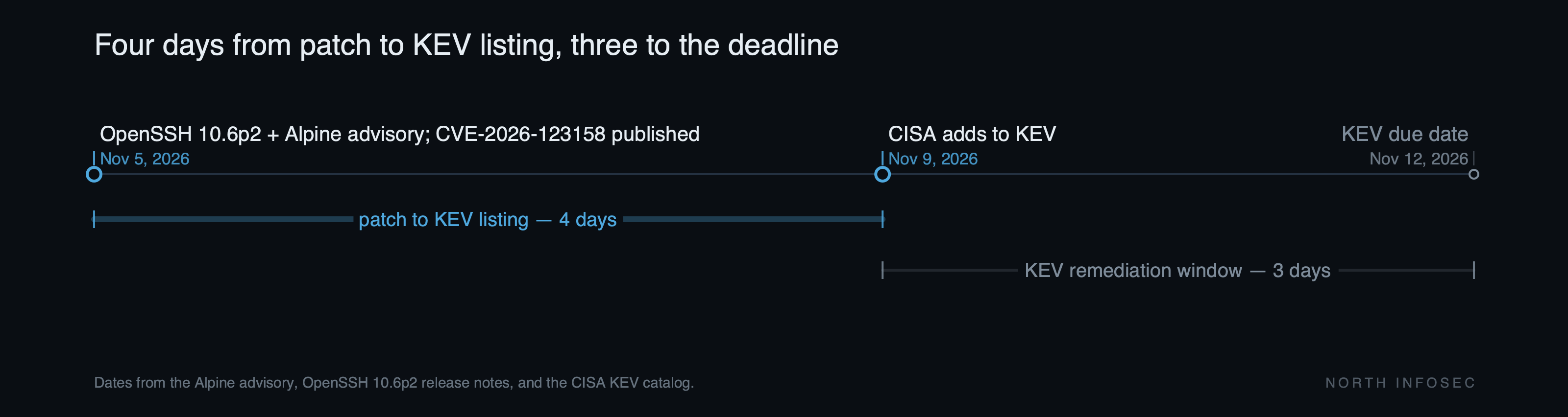
OpenSSH 10.6p2 shipped on 2026-11-05 with a workaround for a password authentication bypass that the trade press has been calling SSHole (CVE-2026-123158). Alpine Linux published its own advisory the same day. By 2026-11-09 CISA had added the flaw to its Known Exploited Vulnerabilities catalog with a due date of 2026-11-12 — a fix on Thursday, a federal deadline the following Thursday, and reported exploitation somewhere in between.
The mechanism
When sshd is built without PAM — Alpine's default openssh-server package — it hashes the submitted password with crypt() and compares the result against the stored field in /etc/shadow. Per Alpine's advisory, "musl's crypt() returns the string * as an error indicator when the key is over 256 bytes long. * is also exactly what the stored field contains for every account with no password, so the 'hash' matches and the login succeeds." Alpine puts the triggering length at 257 to 1024 bytes; NVD phrases the same thing as "any password between 256 and 1024 characters."
OpenSSH's own release note is blunt about where this sits: "We consider the root cause of this bug to be outside sshd, but it is exploitable via sshd and can be avoided there." It is CWE-394, an unexpected return value — the login path trusts a sentinel that crypt() returns on bad input and reads it as a successful match.
The practice: determine the state, not the version
Every piece of coverage ends at the same instruction — patch OpenSSH — and the fixed-version table below is real and worth applying. But the thing that decides whether a given host is exploitable is not a version number. It is three facts you read off the running machine, and none of them is the package version. Alpine's four preconditions, all of which hold or do not hold on a live host:
openssh-serverbuilt without PAM, oropenssh-server-pamwithUsePAM no.PasswordAuthentication yes— the OpenSSH default unless changed.- An account whose password field is
*(no password):rooton a stock install, any key-only user added without a password, directory-service users with no shadow entry, thealpineuser on the tiny-cloud images. - At least one local account with a
$5$or$6$password hash.
The fourth condition is the one that moves. A host can satisfy the first three on the day it is provisioned and still be safe, because no account yet has a real hash to borrow a salt from. It crosses into the exploitable state later, when someone adds one. Alpine says this plainly about its cloud images: "They are safe on first boot. They become exploitable as soon as any $6$ hash exists on the machine, for example when an admin sets a console password, or user-data adds a user with hashed_passwd. An attacker then gets a shell as alpine and can use doas to become root."
Read that sequence as an attack path: alpine is a reachable account with no password, doas is passwordless in the stock image, and root is one command past that. The event that opened the path was a helpdesk action — setting a console password — that nobody logged as a security change, and that an annual or quarterly assessment taken before it happened would have passed.
This is why a version check answers wrong in both directions. A host running a fixed package can still have PasswordAuthentication yes and a * account and a $6$ hash sitting behind a daemon that was upgraded but never restarted — the fix is in the file, not in the process serving logins. And an "affected" package version flags every Alpine host in an inventory identically, including the ones with PasswordAuthentication no that were never exposed. The cost of doing this right is that you track account-record state, not just package versions, and you re-check after any change that sets a password — which is more work than reading one line of apk output, and is the only thing that actually answers "is this us."
If you cannot patch and restart this week, the clean compensating control is PasswordAuthentication no; openssh-server-pam with UsePAM yes is also not affected, and locked accounts whose field is ! never match. This is the same pattern as a KEV entry whose required action is not a simple patch: the catalog listing tells you to act, not what acting means on your hosts.
How to check this week
sshd -T | grep -i passwordauthentication— is ityes?awk -F: '$2=="*"' /etc/shadow— which accounts have no password set?awk -F: '$2 ~ /^\$[56]\$/' /etc/shadow— does any account have a$5$/$6$hash?- Grep
/var/log/messagesforAccepted password foragainst any account the first command returned — a password login to a no-password account is the signature. - Confirm
sshdwas restarted (rc-service sshd restart), not just upgraded. Upgrading the package does not replace the running daemon.
The fixed openssh versions, including the branches past end of support — Alpine 3.21 went end of support on 2026-11-01 and received a fix anyway, as did every branch back to 3.16:
| Branch | Fixed openssh version |
|---|---|
| edge | 10.6_p2-r0 |
| 3.24 | 10.3_p1-r2 |
| 3.23 | 10.2_p1-r1 |
| 3.22 | 10.0_p1-r11 |
| 3.21 | 9.9_p2-r1 |
| 3.20 | 9.7_p1-r6 |
| 3.19 | 9.6_p1-r3 |
| 3.18 | 9.3_p2-r4 |
| 3.17 | 9.1_p1-r7 |
| 3.16 | 9.0_p1-r6 |
The point releases carrying the fixed package are 3.21.10, 3.22.8, 3.23.8 and 3.24.4. This is the opposite problem to a KEV listing that names the narrowest version range: here no version tells you enough, because the exposure lives in /etc/shadow and sshd -T, and it arrives on its own schedule.
North InfoSec runs AI-assisted penetration testing and security assessments, including the kind of chained testing described above. northinfosec.com