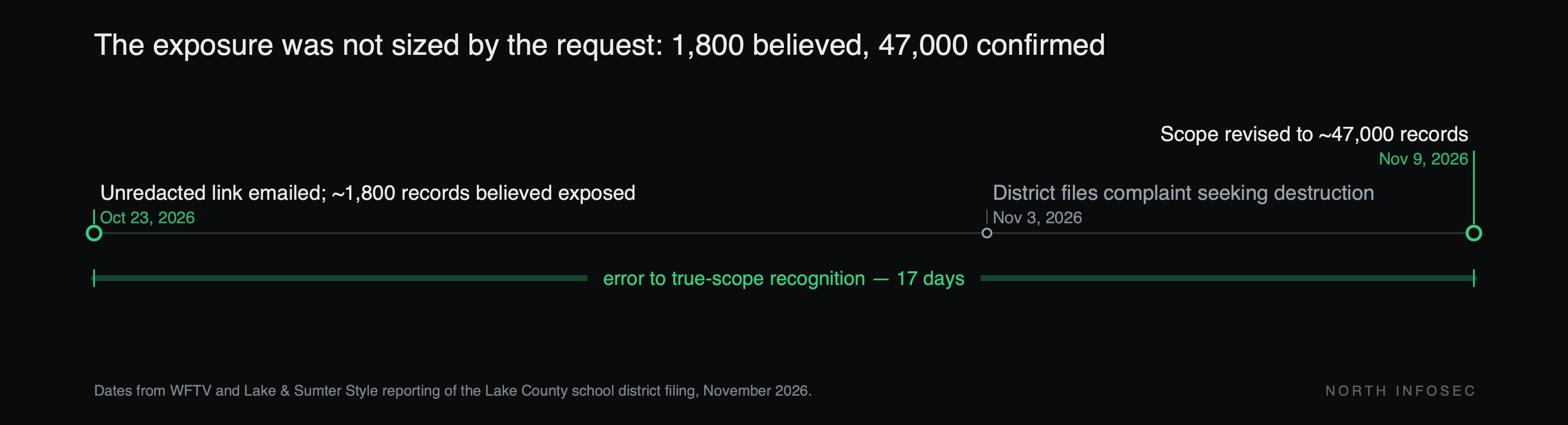
On October 23, 2026, an employee of the Lake County, Florida school district answering a public-records request uploaded eight unredacted files instead of their redacted versions and emailed the requester a link to them, according to the district's account relayed by WFTV and Lake & Sumter Style. The district first believed about 1,800 student records were exposed. By the November 9 school board meeting it had revised that to roughly 47,000 — education and disability records covering, in effect, the student body. The district filed a complaint in the Fifth Judicial Circuit on November 3 seeking an order to destroy the files; the parent who received them has declined. No attacker was involved.
The coverage frames this as a lawsuit over who holds a file and whether they will delete it. The control failure underneath is the more useful story. A request for a narrow set of records returned a link that reached roughly 47,000. Two things had to be true for that to happen: the files the link pointed at were unredacted, and the location it pointed at held far more than the request asked for.
The district has not described how that link was built, so what follows is about the class of failure, not this exact folder. The shape is familiar. Fulfillment happens against the live store: a clerk gathers responsive files from where the records already live, and the share link inherits the scope of that location rather than of the request. Redaction is the only thing standing between "the responsive files" and "everyone's," and redaction is a manual step a busy person performs by hand, eight files at a time. When it slips, nothing downstream catches it, because nothing downstream was ever limiting how much the link could carry.
That the count moved from 1,800 to 47,000 is the tell. Roughly two and a half weeks passed before the district grasped the true scale, because nobody in the workflow knew how large a single action could get. The exposure was not sized by the request; it was sized by whatever the link could reach.
Scope the action, not just the actor
The instinct after this kind of mistake is a training refresh: remind staff to double-check redactions. That addresses the symptom. The durable control makes it structurally impossible for one fulfillment action to reach beyond the records that action is for.
Concretely, separate the place records live from the place records are shared from. A request gets its own staging location. The responsive files — redacted — are copied into it, and the share link is generated against that folder and nothing else. The link cannot reach 47,000 records because 47,000 records were never in the folder it points at. This is the same question as what a web app's database user can actually read: the fix is not trusting the operator to request the right rows, it is making the connection able to see only the rows it should.
Three properties make a staging location safe:
- Only redacted copies exist in it. Unredacted originals never get copied into a shareable location, so a missed redaction exposes a file that was already cleared rather than the raw record.
- Links carry per-file grants and expire. A link scoped to specific files cannot be widened by dropping more files beside it, and an expiry caps how long a mistake stays live.
- The export is capped. A report or extract that physically cannot return more than N records turns "we released the student body" into "we released the fifty we meant to."
Name the cost honestly: this adds a copy step and a review step to every records response, and records clerks are already behind. Someone has to own verifying that the staging folder contains only what it should before the link goes out. The cheap version — sharing a link to where the files already sit — is cheap precisely because it skips that check, which is why it is the default and why this keeps happening.
If you cannot rebuild the fulfillment workflow this quarter, the compensating move is narrow: generate every external share link against a copy in an isolated folder with explicit per-file access, set an expiry, and confirm the link's scope before sending. It is weaker than a staged workflow. It is much better than a link that inherits the permissions of the drive the records live on.
What to check this week
- For every process that fulfills bulk or records requests, does the share link point at a request-scoped folder, or at a location that also holds other people's records?
- What is the largest number of records any single export, report, or share link in your environment can return? If you do not know, that is the finding.
- Which accounts — human and service — can read your entire student or customer table in one query? Keep a current inventory of what you hold and who can reach it.
- In your shareable locations, do unredacted originals sit alongside the redacted copies?
- Do external links expire and carry per-file grants, or do they inherit folder-level access?
The honest version of all five is one question: what is the largest thing one person or one action can hand out, and does anything stop it short of a human remembering to check?
North InfoSec runs AI-assisted penetration testing and security assessments, including access and export-scope reviews of the kind described above. northinfosec.com