CISA added CVE-2026-102895 to the Known Exploited Vulnerabilities catalog on November 9, 2026. It is an authentication bypass in GPUStack, an open-source server for running AI inference across a pool of GPUs, and it carries a CVSS of 9.8. The project's advisory (GHSA-gj9m-f8ph-pmhr) records it exploited in the wild against a version 2.1.1 deployment, running reverse shells from attacker-created inference backends. The exploitable configuration is the one the project's own documentation recommends.
That configuration is a single nginx block — GPUStack bound to localhost, with proxy_pass http://127.0.0.1:<port> in front of it. It is roughly how every self-hosted web application gets exposed.
What actually happens
get_current_user, in gpustack/api/auth.py, promotes any request whose source is considered loopback to the built-in administrator account. This happens whenever force_auth_localhost is False, the default. The reasoning: a request from 127.0.0.1 belongs to someone already on the box, and that someone is trusted.
A same-host reverse proxy breaks that completely. When nginx forwards to http://127.0.0.1:<port>, the connection GPUStack sees originates from the proxy on the same host, so its socket peer is always 127.0.0.1. Every remote request, from anywhere on the internet, arrives wearing the loopback address — no header, no credential, no exploit code; the advisory verified it end to end. A second path hits deployments that read a forwarding header: a client sends X-GPUStack-Real-IP: 127.0.0.1 and the application believes it.
Either way the result is full unauthenticated admin: read and modify users, models and workers; mint a persistent API key scoped ["*"] that stays valid from any source IP; read worker credentials and cloud-provider secrets. The admin-only POST /v2/inference-backends/from-yaml endpoint turns that into code execution from a definition the server was willing to run on the GPU hosts — which is what the in-the-wild activity used.
The practice: never treat a network address as a credential
The advisory states its own fix as a principle, and it is the right one: do not derive authentication from the request's network source. The socket peer, X-Forwarded-For, RemoteAddr, a custom real-IP header — none of them is evidence of who is calling. They are evidence of what is one network hop away, which behind a proxy is always the proxy.
It rarely looks like a bug in review, so grep for it directly: anything that compares a client address — 127.0.0.1, localhost, the socket peer, X-Forwarded-For, a custom real-IP header — against an allowlist and grants privilege on a match. "Internal only" admin routes protected by binding to 127.0.0.1 are the common shape. Binding to localhost is the cheapest-looking control there is, and it is load-bearing right up until someone puts a proxy in front of the service — a networking change nobody routes past security, because it reads as plumbing.
Where you depend on a real-client-IP header, the edge has to strip any client-supplied copy and set its own, not append — an appended header leaves the attacker's value in the list for the application to read. If you can't change the application — GPUStack's own case for anyone not yet on 2.2.0 — set force_auth_localhost=true, strip X-GPUStack-Real-IP at the proxy, and keep the API off untrusted networks behind a VPN. That costs a proxy-config review and a VPN hop, and it is weaker than removing the loopback trust, but far better than the default.
The fix is in GPUStack 2.2.0 — but finding that out was the other half of the problem.
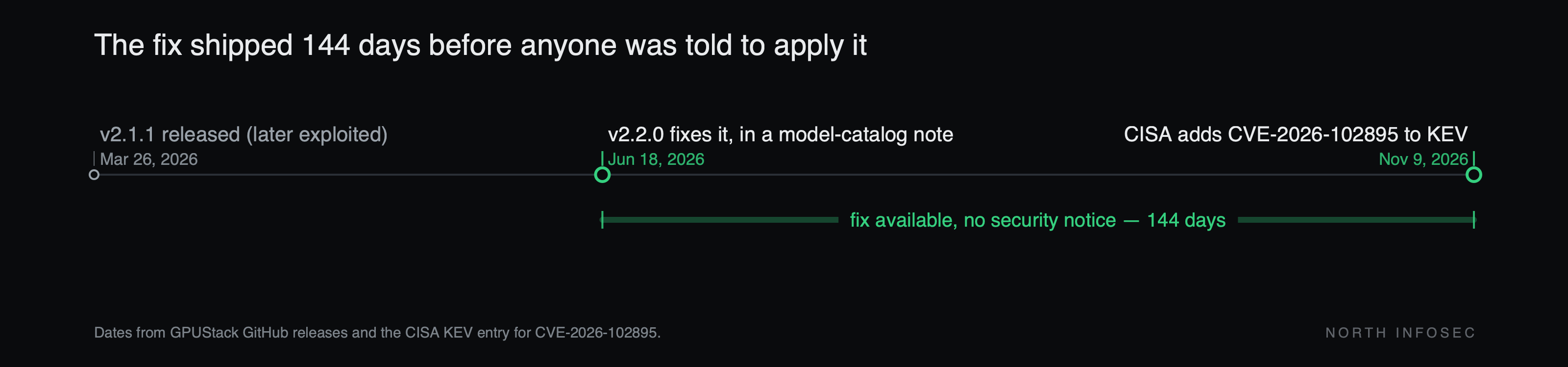
Version 2.2.0 shipped on June 18, 2026. Its release notes are a model-catalog changelog — new LLMs, image and audio models, Kubernetes install work — with no security section and no mention of an authentication bypass. CISA listed the CVE 144 days later, on November 9. For nearly five months there were two populations: teams on 2.2.0 or later who were safe and never knew why, and teams on 2.1.x given no security reason to move. A version scanner helped neither — the vulnerable condition is not a version string, it is the relationship between the app and the thing in front of it. It is the same reason a vendor's release notes are a weak signal of whether a fix is security-relevant: a changelog records features, not the quiet hardening shipped alongside them.
What to check this week
- Grep your code and config for anything that treats
127.0.0.1, the socket peer,X-Forwarded-For, or a custom real-IP header as an authorization signal rather than a log field. - Confirm your edge strips client-supplied real-IP / forwarding headers and sets its own, rather than appending.
- Pick one admin endpoint on an internal service and call it from outside the proxy. Watch whether the application believes you.
- List every API key on your inference and admin platforms and account for each — an admin key scoped
["*"]that nobody remembers minting, valid from any source IP, is the signature of this attack. - For anything "protected" only by binding to localhost, note what breaks if a proxy is ever placed in front.
The blast radius generalizes past GPUStack: an admin bypass on an inference platform reaches worker credentials and cloud-provider secrets — the same exercise as knowing what a single compromised service account can read. An auth check that trusts the network source is not a smaller bug because it only fires "from localhost" — behind a proxy, localhost is everyone.
North InfoSec runs AI-assisted penetration testing and security assessments, including the kind of chained testing — unauthenticated entry to admin API key to secrets to code execution — described above. northinfosec.com