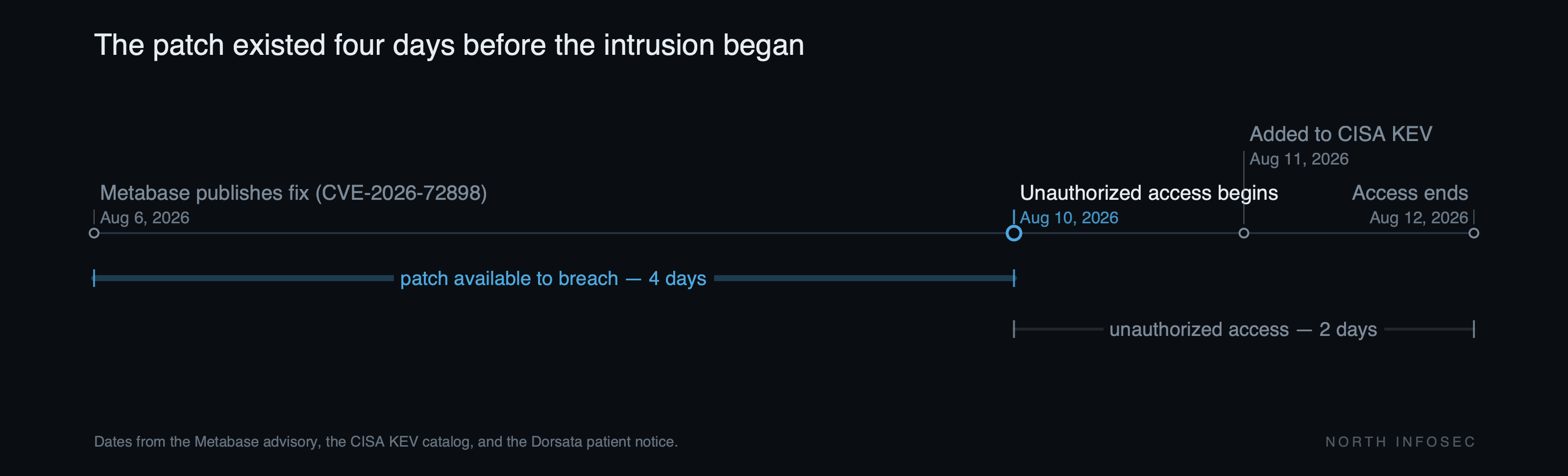
Dorsata, an Arlington, Virginia company that builds electronic medical records software for women's health providers, notified 58,249 patients that their records were exposed through a self-hosted copy of Metabase, the open-source business intelligence tool. The entry point was CVE-2026-72898, an unauthenticated SQL injection that Metabase disclosed on August 6, 2026 and that CISA added to its Known Exploited Vulnerabilities catalog five days later. The attacker reached Dorsata's database between August 10 and 12 — after the fix already existed. No Florida organization has been named in this one, so treat it as a national pattern to check against your own stack, not a local incident.
How one request became admin
The flaw is CWE-89. The password-reset endpoint, POST /api/session/reset_password, accepted undeclared fields in the request body, and Metabase's query builder interpreted that input as SQL against its own application database. One unauthenticated request yields administrator access to the instance — CVSS 10.0, no login, no user interaction, low complexity. Both Metabase and NVD score it 10.0.
The mechanics have been written up well by several researchers, so that is not the interesting question. The interesting question is what admin on a BI instance is actually worth. A dashboarding tool exists to read everything: it holds stored connection credentials for every database someone ever wanted a chart from — the production replica, the warehouse, the billing system, the analytics copy of the EMR. Those credentials live in the Metabase application database, which is exactly what the injection reaches. Compromise Metabase and you have not breached a reporting tool; you have inherited its entire address book of databases and the keys to each one.
That is the structural reason this pattern recurs. BI tools get filed under "internal," so they sit on a VPN-optional segment and inherit the relaxed patch cadence of other internal apps — while holding broader database reach than the application servers everyone does keep current. The same instinct that leaves an internal tool reachable also assumes a service bound to localhost is out of reach, and both assumptions fail the moment the box answers a request from the internet.
The practice: treat an exposed Metabase as a credential-rotation event
Here is the part most of the CVE coverage stops short of. Patching CVE-2026-72898 closes the injection. It does nothing about what an attacker did while the hole was open. If your instance was internet-reachable during the exposure window, the connected-database credentials Metabase stored are compromised, and a successful admin takeover would have exported them. Metabase's own advisory says this plainly, and it amounts to treating the upgrade as the moment to check for compromise: revoke every active session, remove unrecognized API keys, audit administrator accounts for changes, and rotate the credentials for every connected database.
Rotation is the step that gets deferred, and the reason is the same every time. The warehouse service account Metabase uses is wired into other things nobody has a current inventory of, and rotating it breaks every dashboard and pipeline pointed at it. That cost is real. The version that survives contact with a real environment is to write the inventory down once, before you need it: for the Metabase service account on each connection, which account is it, what privilege does it hold, and what else depends on it. That document turns a multi-day outage into a scheduled window — and it is also the answer to the blast-radius question a scanner cannot answer. The damage is bounded by what that database user can actually read, not by the Metabase version number.
If you cannot rotate this week, the weaker-but-real position is to pull the instance off the public internet, revoke sessions at the database level, and scope the service accounts to read-only least privilege so the next compromise reads less. Revoking sessions is an explicit action, not a side effect of the upgrade:
-- Metabase application database: invalidate every existing session
DELETE FROM core_session;
Blocking /api/session/reset_password at the proxy is a valid stopgap before you can upgrade. It is a stopgap, not the fix.
What to check this week
- Is any self-hosted BI tool — Metabase, Grafana, Superset — reachable from the public internet rather than VPN-only? That is the first question, and for most teams the honest answer is "I would have to look."
- Is Metabase on a fixed release: 0.58.24, 0.59.21, 0.60.17, 0.61.11, 0.62.9, or 0.63.5 — or the Enterprise equivalents 1.58.24, 1.59.21, 1.60.17, 1.61.11, 1.62.9, 1.63.5?
- If the instance was ever exposed during the exposure window, were the connected-database credentials rotated — or only patched?
- For each database Metabase connects to, is its service account read-only and scoped to the tables the dashboards actually use, or a broad account that can read everything?
- Can you produce warehouse query logs covering August 6–12 to see what that account ran? If the logs have already rolled off, that is the finding.
The reporting does not establish that Dorsata's connected credentials were used beyond the initial access, and it may turn out they were not. The pattern holds regardless: on a BI tool that was exploitable and exposed, the patch is where the response starts, not where it ends.
North InfoSec runs AI-assisted penetration testing and security assessments, including the kind of chained testing — unauthenticated flaw to admin to stored credentials to connected databases — described above. northinfosec.com