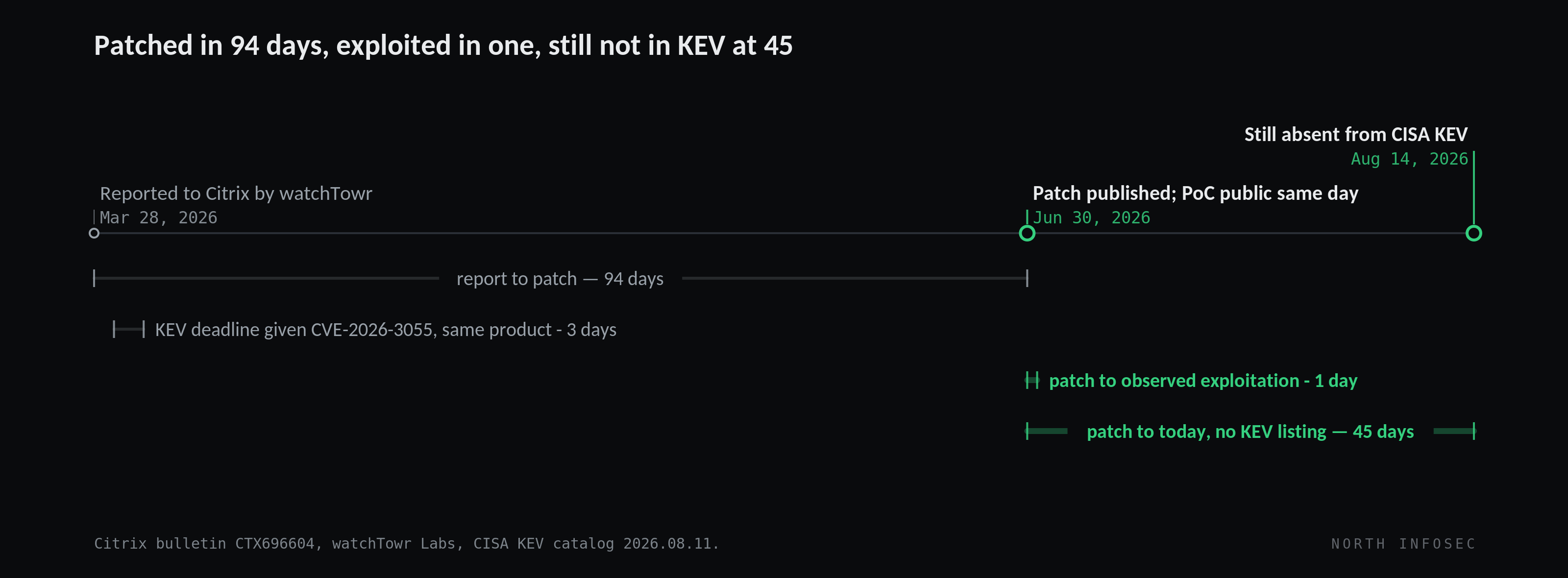
Citrix published its bulletin for CVE-2026-8451 on June 30, 2026, patching a memory overread in NetScaler ADC and NetScaler Gateway. watchTowr Labs, which had reported the bug on March 28, published its research and a proof-of-concept the same day. Within one to two days, sensors run by Lupovis and CrowdSec recorded exploitation attempts against internet-facing appliances.
Forty-five days later it is not in CISA's Known Exploited Vulnerabilities catalog. I pulled the feed on August 14 against catalog version 2026.08.11 — 1,665 entries, and this is not one of them.
What the bug is, and what it is not
The CVE record is precise: "Insufficient input validation in NetScaler ADC and NetScaler Gateway leading to memory overread if NetScaler ADC or NetScaler Gateway is configured as a SAML IDP."
Two constraints in that sentence do most of the work, and most coverage dropped both.
First, the precondition. The flaw is in parsing a client-supplied AuthnRequest, which only an identity provider processes — an appliance acting as a SAML service provider never runs that code path. watchTowr: "for this vulnerability to be exploitable ... the NetScaler appliance has to be configured as a SAML IDP."
Second, the size of the leak. The overread stops at control characters — "this overread will terminate the out-of-bounds read when various control characters are read, such as NULL (or even >)" — so in watchTowr's testing, "by varying the request length, we could consistently squeeze a few bytes out of the server." A few bytes per request, not the kilobytes CVE-2026-3055 gave up in March.
What came back was mostly fill pattern plus one value that "appears to be a data pointer," which watchTowr declined to characterize further. No session token, no SAML assertion and no credential has been shown leaking through this bug by anyone, and Citrix has issued no post-patch session-termination or rotation guidance for it. The "CitrixBleed again" framing carried the 2023 story's conclusion — leaked memory contains session material, so patching alone does not evict the attacker — onto a bug where nobody has demonstrated it.
The practice: derive exposure from your own configuration
Four public signals about this CVE point in different directions. Citrix, as CNA, scored it CVSS 4.0 base 8.8. NVD's primary metric is CVSS 3.1 base 7.5. CISA has not listed it at all, six weeks after exploitation was reported. The trade press called it CitrixBleed.
A team keyed to any one of those got a different answer. None of them knows whether your appliance is a SAML IdP — the only variable that decides whether this CVE can touch you, and the one piece of information you already own.
So: for any edge-appliance CVE that states a precondition, resolve the precondition against your own running configuration before you look at severity or KEV. Here that means checking whether a SAML IdP profile or policy is bound to a virtual server. The object is created by add authentication samlIdPProfile, so if it exists it is in the running config — dump the config with show ns runningConfig and search it for samlIdPProfile and samlIdPPolicy. Nothing bound means you are not exposed and this goes in the normal patch cycle. Something bound, reachable from the internet, means an out-of-cycle change tonight.
The cost is organizational rather than technical. Someone has to know the appliance well enough to read its configuration, and on most teams the NetScaler belongs to networking while the CVE lands in security's inbox. That handoff is why precondition checks get skipped and a severity number gets used instead: the number requires nobody to log in. The version that survives contact with a real team is to write the check down once per appliance class as a runbook step with the command in it, so answering takes ten minutes instead of a meeting.
If you cannot get the configuration answer quickly, patch internet-facing instances first regardless of precondition, and restrict the SAML IdP virtual server if you have one and cannot patch tonight. That is weaker than knowing, and much better than waiting for a KEV listing that has not arrived.
One more thing about timing. watchTowr's tool went to GitHub the day the patch shipped, and Lupovis reported the payload it observed matched that tool's structure. The interval between "a fix exists" and "working tooling is public" was zero. Plan the exposure window on that assumption — the same collapse showed up when a silent vendor fix preceded its CVE by 95 days, and it is the reasoning behind CISA cutting its remediation deadlines to three days.
What to check this week
- For each NetScaler you operate: is a SAML IdP profile or policy bound to a virtual server, and is that virtual server reachable from the internet?
- What version is each appliance on? Affected are 14.1 before 14.1-72.61, 13.1 before 13.1-63.18, 14.1 FIPS before 14.1-72.61, and 13.1 FIPS/NDcPP before 13.1-37.272.
- Does your vulnerability workflow have a step that reads preconditions out of the advisory, or does it route on CVSS alone?
- If KEV membership is your trigger: which CVEs affected you in the last year and never got listed? This is one.
- Who can read a NetScaler running config today, without scheduling anything?
The exploitation reporting traces largely to one vendor's sensor network, and Citrix credited the researchers without confirming in-the-wild attacks. That ambiguity is normal this early, and it is the argument for the precondition: it is the one fact here that does not depend on anybody else's telemetry.
North InfoSec runs AI-assisted penetration testing and security assessments, including the edge-appliance configuration review described above. northinfosec.com