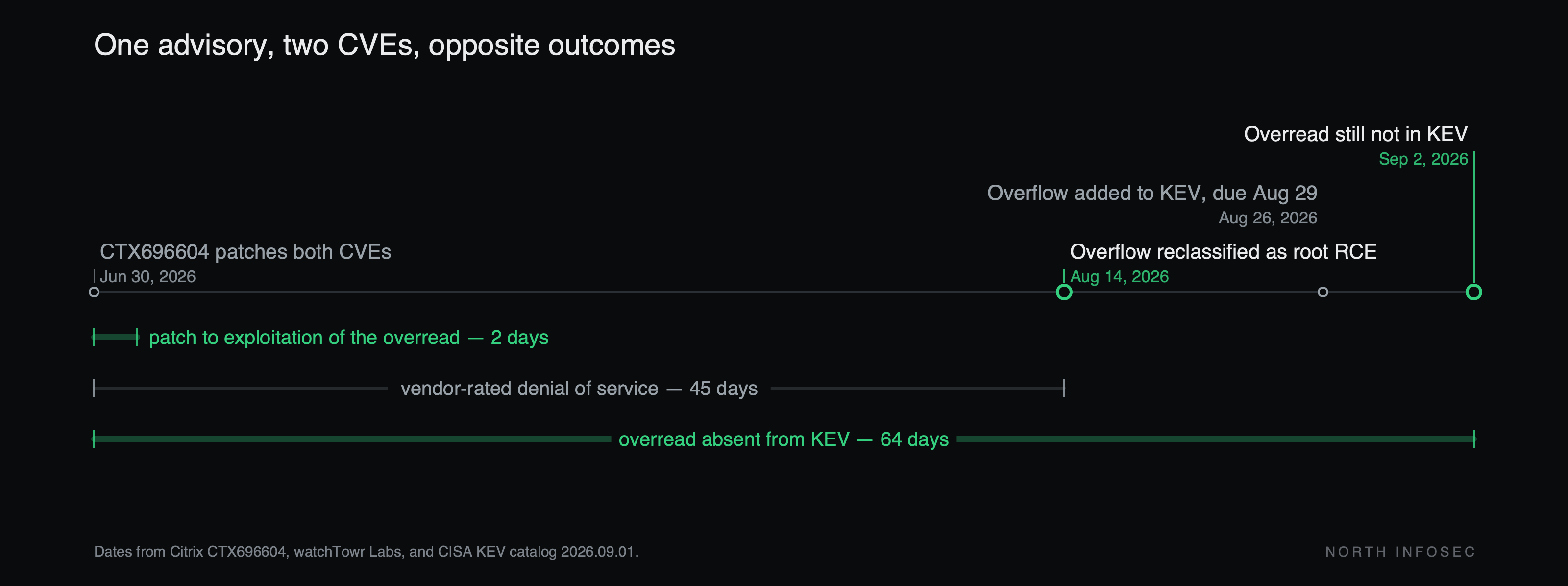
Citrix advisory CTX696604 shipped on June 30, 2026 and closed six NetScaler CVEs. Two are still open 64 days later. CVE-2026-8451 drew exploitation attempts within a day or two of the patch and is still absent from CISA's Known Exploited Vulnerabilities catalog, as of version 2026.09.01. CVE-2026-8452, which Citrix described as a denial of service, was demonstrated as unauthenticated root RCE on August 14, exploited about a week before CISA listed it on August 26, and handed a three-day federal remediation deadline.
Same advisory, same day, same vendor severity score. What separated them was one clause in each description.
What the two descriptions say
NVD timestamps both records at 2026-06-30T13:19:33, and Citrix, as CNA, scored both CVSS 4.0 8.8. The operative clause sits at the end of each:
CVE-2026-8451 — Insufficient input validation in NetScaler ADC and NetScaler Gateway leading to memory overread if NetScaler ADC or NetScaler Gateway is configured as a SAML IDP
CVE-2026-8452 — Memory overflow vulnerability NetScaler ADC and NetScaler Gateway leading to unpredictable or erroneous behavior and Denial of Service if the appliance is configured as a Gateway (SSL VPN, ICA Proxy, CVPN, RDP Proxy) or AAA virtual server
A SAML identity provider is a deliberate configuration most NetScaler operators do not run. "Configured as a Gateway or AAA virtual server" describes what a NetScaler Gateway is for, so it matches most deployments in the field.
The narrow one got exploited immediately and got called CitrixBleed. The near-universal one was labelled a denial of service and triaged as one. We published a running-config check for CVE-2026-8451 on August 14. It was correct and it was not sufficient: a team that ran it, found no SAML IdP profile bound, and stood down closed 8451 and left 8452 exactly where it was.
The reclassification
watchTowr's August 14 writeup walks that "denial of service" to root: a heap overflow in SAML signature canonicalization inside the AAA service, converted into a write-what-where primitive, used to hijack the tx_pkt_complete_fptr function pointer, with signal handlers disabled so the appliance would not reboot, ending in a PHP webshell running as root.
The signal-handler step matters. The visible symptom of a failed attempt against a memory-corruption bug is a device that crashes and comes back. Suppressing the crash removes the one thing an operator would have noticed. A vendor impact statement describes what the vendor's analysis found, not a bound on what is reachable — the same gap that appeared when a silent fix left operators nothing to verify.
Four signals, and the one that ranked them correctly
Every public signal about these two CVEs existed on June 30. They did not agree.
- Citrix CVSS 4.0, as CNA: 8.8 for both. No separation.
- Citrix impact statement: memory overread versus denial of service. Ranks 8451 higher.
- CISA KEV: 8452 listed August 26, 8451 absent at 64 days. Ranks 8452 higher, 57 days late.
- NVD CVSS 3.1, scored by NVD analysts: 8451 at 7.5 HIGH, 8452 at 9.8 CRITICAL.
Only the last put 8452 above 8451 on the day the advisory shipped, and it is the score most teams skip, because the CNA's 4.0 figure is what feeds display first. A 9.8 carrying full confidentiality, integrity and availability impact is not a denial of service.
The practice: resolve the precondition per CVE, not per advisory
When an edge-appliance advisory lands, read the precondition clause out of each CVE description and resolve each against running config. Not the advisory's top-line severity, and not one check per advisory — CTX696604 carried six CVEs and at least two distinct preconditions.
For these two, that is three commands:
show ns runningConfig | grep -i "samlIdPProfile\|samlIdPPolicy"   # CVE-2026-8451
show vpn vserver                                                  # CVE-2026-8452
show authentication vserver                                       # CVE-2026-8452
The cost is the same as last time: somebody has to log in and read the configuration, and on most teams the NetScaler belongs to networking while the CVE lands in security's inbox. What is new is that the runbook cannot be written once and reused, because the precondition changes per CVE. The step becomes "extract the clause, then check it" — a few minutes per advisory rather than a saved command.
If you cannot get a configuration answer quickly, patch to current builds and skip the triage — but check which build that is. CTX696604's fixes for 8451 and 8452 are 14.1-72.61 and 13.1-63.18 (13.1-37.272 for FIPS and NDcPP), and those do not cover CVE-2026-19490, the CVSS 4.0 9.3 authentication bypass Citrix patched on August 19 in CTX696939, which affects builds through 14.1-73.32 and 13.1-63.21. Landing on the June build leaves 19490 open, and it is not in KEV either.
What to check this week
- Is a SAML IdP profile or policy bound to a virtual server? That is the 8451 question; for most operators the answer is no.
- Is the appliance configured as a Gateway or an AAA virtual server? That is the 8452 question; for most operators the answer is yes.
- If any appliance was internet-facing on an unpatched build after August 20: look for PHP files under the web root, and for an uptime showing no restart where you would expect one.
- Does your triage read the precondition clause per CVE, or route on the advisory's headline severity?
Exploitation reporting for 8451 traces largely to a few sensor networks, and Citrix has not confirmed in-the-wild attacks for it. As of September 2, 2026, CVE-2026-8451 and CVE-2026-19490 are both absent from KEV.
North InfoSec runs AI-assisted penetration testing and security assessments, including the edge-appliance configuration review described above. northinfosec.com