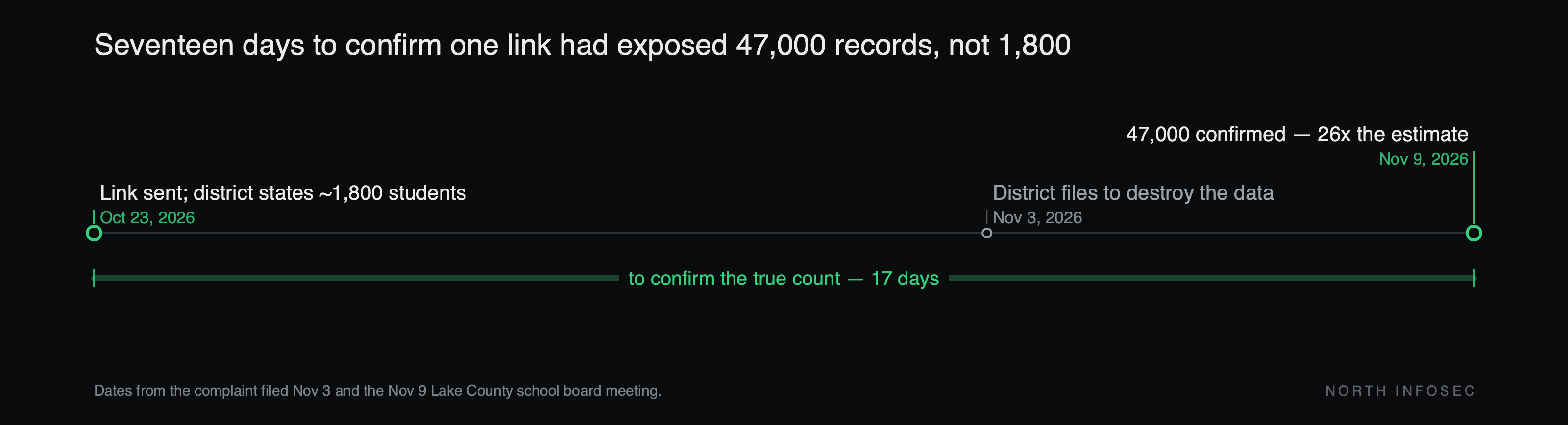
On October 23, 2026, an employee at Lake County Schools in Tavares, Florida was fulfilling a parent's public-records request — the parent had asked for his own daughter's individualized education program records. Instead of the redacted file the request called for, the employee emailed a link to eight unredacted files containing the education and disability records of roughly 47,000 students. The district first described the release as affecting about 1,800 students; at a November 9 board meeting it confirmed the parent's own count of 47,000, and on November 3 it had already filed in the Fifth Judicial Circuit to compel the parent to destroy the data.
The response contained the whole dataset
This was not an intrusion. Nobody exploited anything. A request for one student's records returned the entire student population, and that gap — one subject requested, 47,000 subjects delivered — is the only part worth a technical reader's time.
The control that was supposed to keep the response to one student lived in a human step: which files to attach, and whether they were the redacted copies or the source. When the boundary sits there, the failure mode is a wrong attachment that exposes everything the person fulfilling the request can reach — and the clerk fulfilling a records request can usually reach everyone. There is no login between them and the data, no row-level filter forcing the export down to the named subject, and frequently no log of what left. The response is assembled by hand from a folder or a query that holds the whole population.
That is also why the district spent 17 days unsure of its own blast radius. Nothing counted or bounded what the link exposed, so the first estimate was off by 26×, and it took a parent posting the real number on Facebook to correct it.
Put the boundary on the data, not the email
The practice that prevents this is to scope the data layer so a records-request response cannot contain records outside the request, no matter what the person fulfilling it clicks.
Concretely, that means producing the export from a filtered query keyed to the subject of the request, not by copying files out of a folder that holds everyone. It means share links that inherit the narrowest scope available — the specific file, not its parent folder — and that expire and are addressed to one recipient. And it means logging bulk exports and alerting on them: an export of tens of thousands of records assembled to answer a request about one student should trip an alert before the link is ever sent, not surface weeks later from a Facebook post. This is the same over-broad reach that shows up when a web app's single database user can read every table — the account is scoped to the system, not to the task in front of it, so one export quietly carries far more than the job required.
None of that is free. A scoped-export path is something someone has to build, and redaction review is real, recurring work that a drag-and-drop from a shared folder skips entirely. The honest version is to make the scoped export the only easy path — a tool that takes a case number and returns exactly that subject's records, redacted — so the hard, broad path isn't the one sitting open on the clerk's desktop.
Where the fulfillment stays manual, the compensating control is a second reviewer who cannot be skipped on any response over a set record count, plus a hard cap on what the fulfilling account can reach. Neither is as good as a data-layer boundary. Both are much better than one person deciding, alone and unlogged, which files to attach.
What to check this week
- List every way data leaves the building that isn't an application login: share links, report exports, records-request fulfillment, mail merge. That list is your egress surface, and most of it has never been in a security review.
- Who can mint a share link, and what scope does it inherit by default — the file, or the whole folder it sits in?
- Are bulk exports logged? Would an export of tens of thousands of records trip an alert, or only surface when someone outside the building counts them?
- Is records-request fulfillment in scope for any security review you run, or is it invisible because nobody files it under "application"?
- Can the account used to fulfill requests reach records beyond the subject named in the request? If yes, a wrong click is a full-population disclosure.
North InfoSec runs AI-assisted penetration testing and security assessments, including review of the data-egress paths — exports, share links, records fulfillment — that never appear in an application scan. northinfosec.com