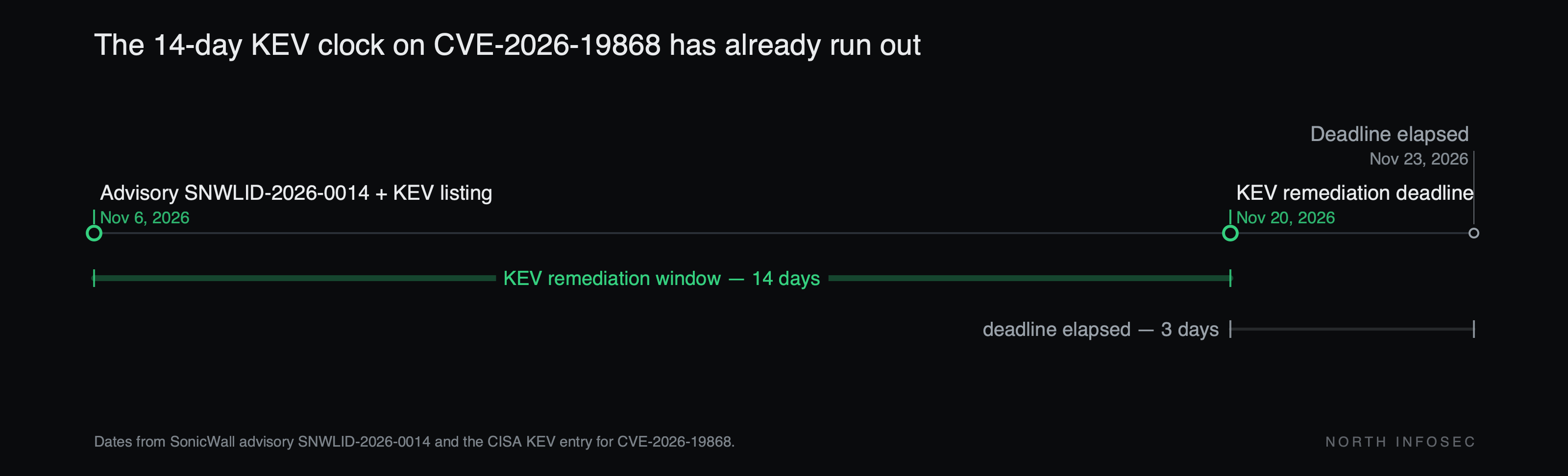
On November 6, 2026, SonicWall published advisory SNWLID-2026-0014 and CISA added CVE-2026-19868 to its Known Exploited Vulnerabilities catalog the same day. The flaw lets a user who holds valid credentials for an alternate authentication method on a SonicOS appliance bypass the SAML authentication enforced on the SSL-VPN portal — and with it, any SAML-enforced multi-factor authentication. SonicWall says it "investigated a report indicating potential exploitation"; CISA's KEV listing is the independent judgment that it is being used in the wild. The federal remediation deadline was November 20. As of this writing, it has already passed.
One appliance, more than one front door
CVE-2026-19868 carries CWE-308, "Use of Single-factor Authentication," and that classification is the whole mechanism. On its own the CVE scores 7.1; the advisory's headline 8.8 belongs to two unrelated bugs — a permissive cross-domain policy and a session-validation flaw — shipped in the same release. It applies only when SAML is enabled for SSL-VPN logins.
Here is what that means in practice. A SonicOS firewall can authenticate a VPN session in more than one way: local users defined on the box, an LDAP or Active Directory bind, a RADIUS server, or SAML. You turned on SAML for the portal, and your identity provider enforces MFA on the SAML path. But a second method — local, or LDAP, or RADIUS — was left enabled, and that method is single-factor. An attacker who can satisfy the second method never reaches the SAML path at all. The factor you believe is mandatory is simply not standing between them and the session.
This recurs because MFA on an appliance is bound to an authentication method, not to the device. The extra method usually got enabled during the initial build or a migration and was never removed, because removing it is a change nobody had a reason to make. The audit recorded "MFA: enabled" and closed the ticket. Nobody enumerated the other doors, because the ticket was about the door they had just locked.
Enumerate every method the portal accepts, not the one you configured
Start with the patch, because for this CVE it is genuinely just the patch. Gen7 firewalls (TZ, NSa, NSsp, and NSv) need 7.3.4-7013 or higher; Gen8 firewalls (TZ, NSa, and NSv) need 8.2.3-8015 or higher. Affected builds are 7.3.3-7015 and older on Gen7, and 8.2.2-8015 and older on Gen8. These are the default edge firewall for mid-market offices, Florida's included, so the install base you are checking against is large and ordinary.
The upgrade closes this instance. It does not close the pattern, which is that the appliance accepts authentication methods you are not accounting for. The durable control is an inventory of your own auth surface: for each SSL-VPN, list every method it will accept, and for each method, confirm whether it carries the second factor you assume is universal. A method that does not is the login path that actually gets used — the weakest remaining door, not the one you hardened.
Then disable the methods nothing depends on. The cost here is real, and it is why the methods are still enabled: a single-factor local account may be your break-glass admin, and an LDAP method may be wired into something you cannot see from the firewall. So inventory before you disable, and expect a maintenance window and at least one surprise about what was quietly relying on a path you were about to remove.
If a single-factor method has to stay — a break-glass local admin is a legitimate reason — do not leave it reachable from the public internet. Restrict it by source address, put the management and portal interfaces behind a separate VPN, and alert on any successful SSL-VPN login that used a non-SAML method. That is weaker than removing the method. It is much stronger than assuming the SAML path is the only one.
What to check this week
- Which SonicOS firewalls do you run, and is each at 7.3.4-7013 / 8.2.3-8015 or higher? The ones you are least sure about are usually the appliances nobody owns.
- Is SAML enabled for SSL-VPN on each box? Where it is, CVE-2026-19868 applies directly; where it isn't, the enumeration lesson still does.
- For every SSL-VPN, list the authentication methods it accepts — local, LDAP/AD, RADIUS, SAML — and mark which ones carry a second factor.
- For any single-factor method still enabled, can you name what depends on it? If you cannot, that is the finding.
- Pull SSL-VPN authentication logs back to at least November 6 and look for successful logins through a non-SAML method. A VPN is how these groups get in, and this is where that would show.
North InfoSec runs AI-assisted penetration testing and security assessments, including the kind of authentication-path enumeration described above. northinfosec.com