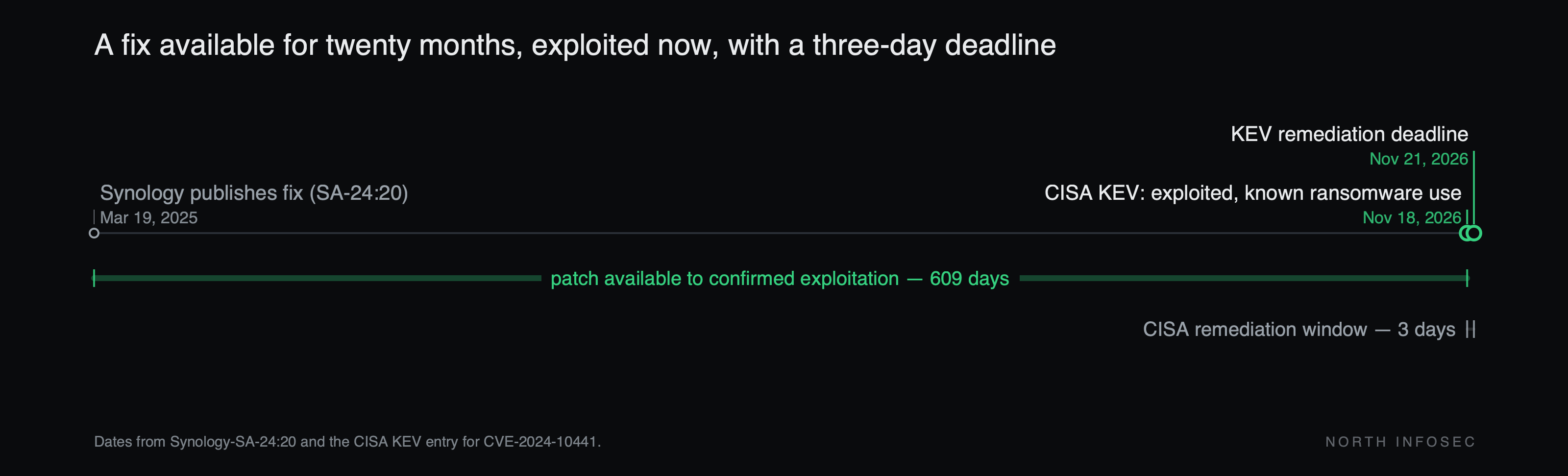
On November 18, 2026, CISA added CVE-2024-10441 to its Known Exploited Vulnerabilities catalog, flagged it as being used in a known ransomware campaign, and set a remediation deadline of November 21 — three days. It is an unauthenticated remote code execution flaw (CVSS 9.8) in the system plugin daemon of Synology DiskStation Manager, the software that runs on Synology NAS boxes. Synology published the fix on March 19, 2025. What changed last week was not the bug; it was confirmation that attackers are now using it, on boxes that have had a patch available for twenty months.
Why this one matters more than its CVSS score
The vulnerability is improper encoding of output (CWE-116) in a daemon that handles system plugins: no credentials, no user interaction, a single unauthenticated request reaches code execution. That is the same mechanical story as a dozen other 9.8s. What makes this one worth a paragraph is where the box sits.
A Synology NAS is usually two things at once. It is the file server — the share every workstation maps, the folder the accounting data and the client files live in. And it is the backup target — the destination for the nightly job off the servers and the laptops. The same appliance holds the crown jewels and the safety net. Remote access gets turned on once, early, so staff can reach files from home, via QuickConnect or a forwarded port, and then the box is quietly on the public internet for years. It rarely lands on a patch calendar, because in most small offices nobody owns it the way they own a server. It is "just the NAS." The build number on it is whatever shipped the day it was racked.
So when CVE-2024-10441 gets exploited against an internet-facing Synology, the attacker does not get a file server or a backup store. They get both, in one move. They have your data to extort and the recovery you would have used to refuse the ransom. "We have backups" quietly assumes the backups outlive the box they sit on, and here they do not.
The practice: make the recovery copy survive the appliance
The specific thing that prevents the worst outcome is not faster patching — it is backup independence. At least one backup copy has to live somewhere the NAS itself cannot reach, authenticate to, or delete. If a compromised DSM account or a root shell on the box can mount, overwrite, or expire the backup, it is not a second copy; it is the same copy. This is the practical content of the 3-2-1 rule that usually gets recited and rarely gets tested: the offline or immutable copy is the one that matters, and it is the one most SMB setups skip because it costs something — a second device, immutable object-lock storage with its own credentials, or a rotation someone physically handles. The version that replicates to a second volume on the same NAS is the version the ransomware already owns. You can test whether your backups can be deleted from the same account that runs them — if the answer is yes, the independence isn't there yet.
Second, the appliance has to exist on paper. The NAS misses every patch cycle because it is not in the asset inventory and has no owner — the same gap that leaves network devices nobody owns running firmware from the year they were installed. A storage or backup appliance reachable from the internet is a server, and it needs the server's patch timeline.
Third — and this is the part the KEV listing specifically demands — patching is not the whole remediation. CISA's required action for this CVE is not "install the update." It flags forensic triage and directs you to evaluate the asset's internet exposure, because a box that has been internet-facing and unpatched since March 2025 may already be compromised. If yours was exposed, applying 7.2.2-72806-1 closes the door but tells you nothing about who was already inside. The patch is a starting point for an investigation, not the end of one.
What to check this week
- Your DSM build against the fixed releases. Critical for DSM 7.2.2 (fixed in 7.2.2-72806-1), 7.2.1 (69057-6), 7.2 (64570-4), and 7.1 (7.1.1-42962-7); Moderate for 6.2 (6.2.4-25556-8). BeeStation OS is fixed in 1.1-65374. Anything below your train's number is affected.
- Whether the NAS is reachable from the internet at all — QuickConnect enabled, a forwarded port, UPnP quietly opening one. The box being on the public internet is the default posture for remote access, not an exception you would remember configuring.
- Whether a backup copy exists that the NAS cannot delete. Try to expire or overwrite the backup from the account that normally runs it. If you can, so can an attacker who owns the box.
- If it was exposed and unpatched, whether it is already compromised — new admin accounts, unexpected scheduled tasks, outbound connections from the NAS. The twenty-month gap between the fix and confirmed exploitation is long enough that "we patched it" and "we are clean" are two different claims.
The NAS is the one device where a compromise erases both the data and the recovery at the same time. That is the reason it deserves the server treatment it almost never gets.
North InfoSec runs AI-assisted penetration testing and security assessments, including mapping which storage and backup appliances are reachable from the internet and whether the backups on them survive the box itself being owned. northinfosec.com