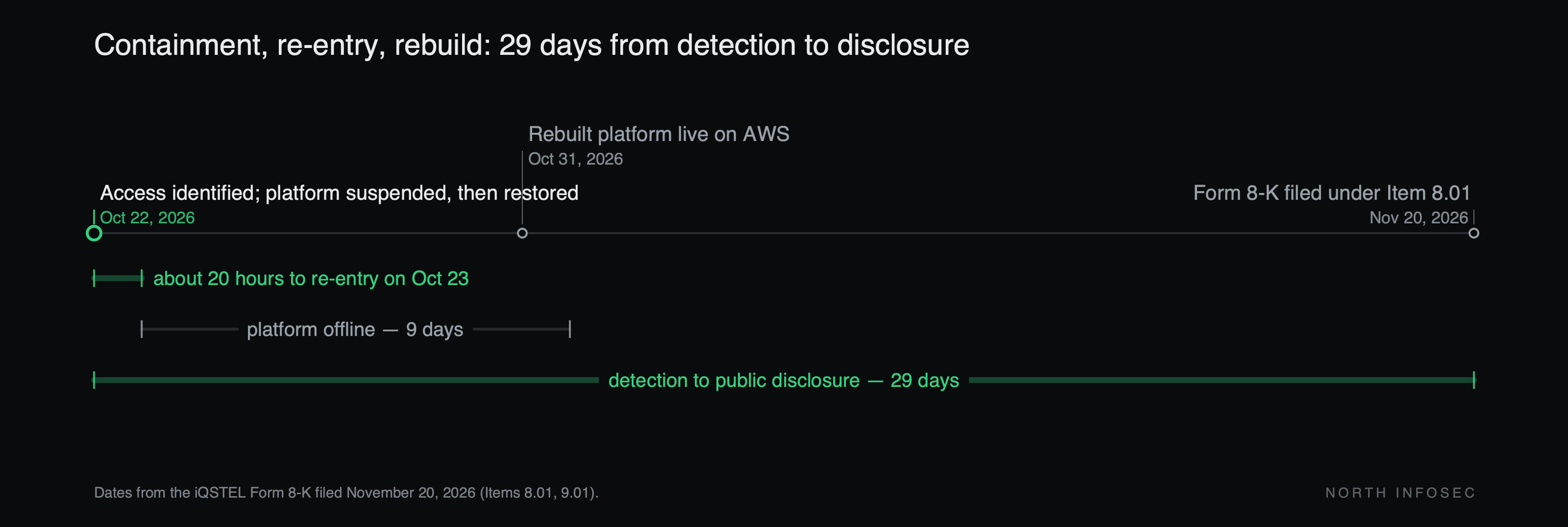
Coral Gables-based iQSTEL Inc. (Nasdaq: IQST) filed an 8-K on November 20 describing an intrusion at GlobeTopper LLC, the 51%-owned subsidiary that runs its digital prepaid and gift card platform. GlobeTopper identified unauthorized access on October 22 and suspended the platform at about 9:00 a.m. Eastern, restoring service that evening. Early on October 23 it detected further unauthorized activity and took the platform and all affected servers offline at about 5:30 a.m. A rebuilt platform on AWS went live October 31; operations resumed in stages from November 1.
The filing names what was taken: "the unauthorized party obtained API credentials and integration keys of certain GlobeTopper business customers." Gift cards with a face value of roughly $70,000 were redeemed without authorization and cannot be reclaimed; the preliminary high-end estimate of revenue not generated during the nine-day outage is $2.5 million, with the permanently lost portion undetermined. The filing is under Item 8.01, not 1.05 — iQSTEL has not determined the incident is material, and would file under 1.05 within four business days of doing so.
The first fix did not evict them
The twenty hours between the first containment and the second detection are the part worth sitting with. GlobeTopper found something, shut down, remediated what it could see, and reopened that evening — and the attacker was still there by dawn. The filing does not disclose the initial access vector, so this is not a claim about how they got in; it establishes that the first pass did not finish, which is why the answer ended up a rebuild rather than a repair, the same call Cisco told email gateway operators to make.
The asset with the longest tail, though, was never GlobeTopper's own. Every business customer integrating with the platform holds a key that authenticates its calls, and that key is a password with no human attached: no login prompt, no MFA step, no session expiry, no device to notice it has moved. A request bearing a valid key from a plausible source is indistinguishable from the customer making it.
What makes a stolen integration key detectable
The filing also says the company "has not identified any unauthorized use of those credentials." Read that precisely. It is a statement about what GlobeTopper's logs showed, not a statement about what happened, and those are the same sentence only if the logging would have caught it.
For a stolen integration key, usually it would not. The attacker's traffic carries a valid key, hits endpoints the customer already calls, and sends well-formed bodies — nothing in the request is wrong. The distinguishing signals are all secondary — source address and ASN, TLS client fingerprint, time of day, endpoint mix, request rate — and most platforms do not retain those per key long enough to answer the question weeks later. CareCloud reported an eight-hour outage to the SEC and later described six days of database access nobody saw; that gap was retention and field coverage, not effort.
The controls that matter make misuse either impossible or anomalous, and they are decided at issuance, not during the incident.
Bind the key to a source. An allowlist of customer egress CIDRs, or mTLS client certificates, turns "used from somewhere else" into a connection failure instead of a log line nobody queries. It is the highest-value control here, and the cost is an onboarding conversation rather than a code change: you have to ask every integrator for their egress ranges, and handle the ones on serverless platforms whose egress IPs rotate. Those get the token exchange below, not an exemption.
Scope each key below the account. One key per integration purpose, authorized for the endpoints that purpose needs, rather than one per customer that can do anything the customer can. The blast radius of a stolen credential is fixed when you issue it, the same way a database grant set Florida's 4.9 million figure years before the intrusion.
Make revocation per-key. GlobeTopper revoked and rotated everything and reissued credentials under additional access restrictions, which is correct and expensive: it makes every customer change code in the same week. A platform that can kill one key without a global rotation event gets to respond proportionally to the next one.
Log the use, not the issuance. Key ID, source address and ASN, endpoint, response code, timestamp — kept 90 days minimum, because the question arrives weeks after the window it asks about.
Where source binding is not available, exchange the long-lived key for a short-lived one: its only privilege becomes minting a 15-minute bearer token, and every mint is an event you can rate-limit, geo-check and alert on. The stolen key still works, but it now produces a countable signal every time it does.
Checks to run this week
- List every customer-issued key your platform holds and the endpoints each is authorized for. If the answer is "all of them," that is the finding.
- Pick one key and answer whether it was used last month from an address other than that customer's. If you cannot, you cannot make the "no unauthorized use identified" statement either.
- Confirm you can revoke one customer's key without rotating everyone's.
- Check retention on whichever request log carries the key ID. Seven days is common and too short.
- Record, per integrator, who holds the key and where they store it. Their secret store is part of your attack surface.
North InfoSec runs AI-assisted penetration testing and security assessments, including the credential scoping and API authorization testing described above. northinfosec.com