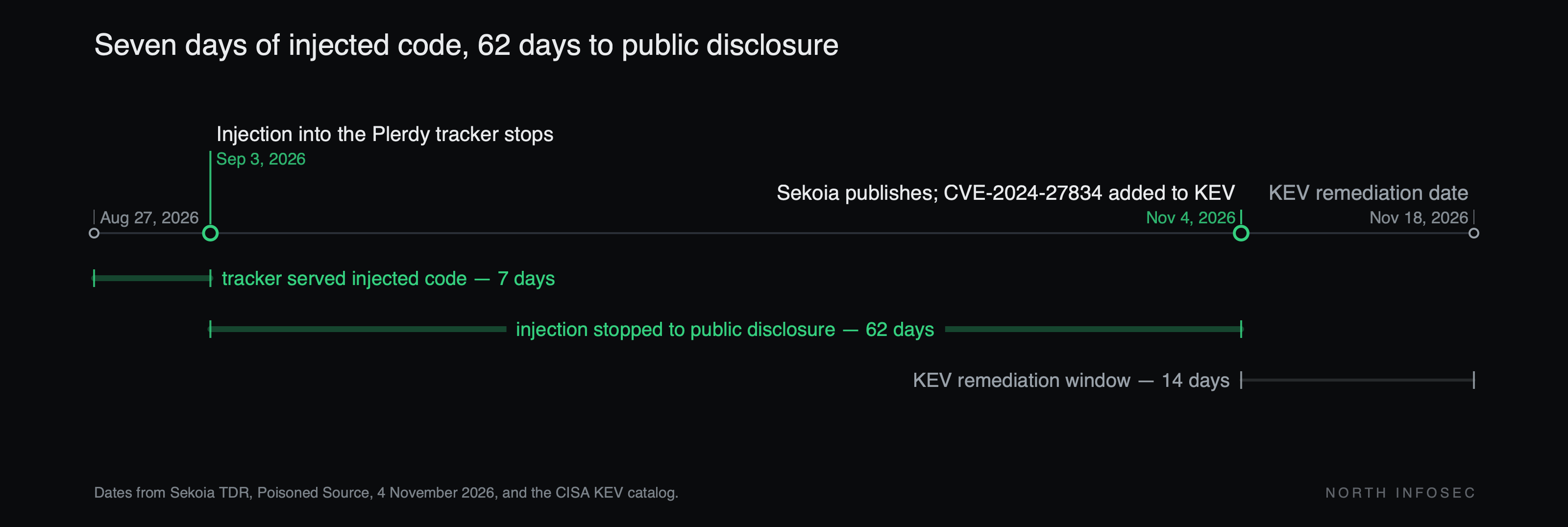
On November 4, 2026, Sekoia's Threat Detection & Research team published Poisoned Source, its analysis of a watering-hole campaign it attributes with moderate-to-high confidence to APT29. One of the three delivery vectors was a supply-chain compromise: between 27 August and 3 September 2026, the operators injected code into a.plerdy[.]com/public/js/click/main.js — the Plerdy SEO Tracker, which Sekoia describes as "loaded by thousands of websites, the large majority of them Ukrainian." Sekoia uncovered the campaign in mid-October. Publication came 62 days after the injection stopped. Among the separately compromised sites, Sekoia identifies one only by sector: "a major industry trade association representing US companies operating in the chemical industry."
The injection left the tracker working
The injected code was a single window.onload handler appended to the end of the legitimate tracker file. Once the page finished loading, it created a second <script> element, pointed it at a different host, and appended it to the document body. The real Plerdy script kept running. Analytics kept reporting. Nothing on the page broke, and nothing in the page's own source changed.
Two details matter more than the payload. First, the second origin — edge-ord.clouds-stacks[.]com — was registered on 26 August 2026, the day before the injection began. Second, it never served the fingerprinting script itself: Sekoia found it HTTP-redirecting to other delivery hosts, and assesses with moderate confidence that it was used as a load balancer across that infrastructure. The origin a site owner could have logged was not the origin that ultimately served the code.
What arrived was a profiler that read the browser and OS version, then requested a matching exploit chain. All three chains Sekoia recovered used vulnerabilities that already had fixes: "None of them contain zero-days or work against fully updated devices. Each flaw was resolved by the respective vendor before this campaign began." CISA added one of them, CVE-2024-27834, to the KEV catalog on November 4, 2026 — the same day the report landed — with a November 18 remediation date.
The practice: enumerate script origins per template, then make the allowlist enforce them
Subresource Integrity is the control people reach for first, and it does not apply here. SRI pins a hash; an analytics vendor ships new code continuously; a pinned tracker breaks on the vendor's next deploy. Nobody pins trackers, and that is a rational decision rather than negligence.
The control that would have fired is script-src. The compromise was inside an allowed origin, but the code execution was not — the browser was told to fetch a script from a host nobody had ever approved:
Content-Security-Policy-Report-Only:
  script-src 'self' https://a.plerdy.com;
  report-uri /csp-report
Report-only blocks nothing and produces the inventory: every external script origin your pages actually fetch, per template, updated continuously. It is the same mechanism that makes report-only CSP worth running on authenticated routes where the URL itself is the disclosure. Switched to enforcing, that one directive refuses the second fetch.
Keep the output as a dated record rather than a current-state list, because the question a disclosure asks is retrospective: were we loading a.plerdy.com between 27 August and 3 September 2026? A report-only log answers that. A spreadsheet somebody last updated in March does not. For each origin on the list, check who holds the domain today as well — a third-party script origin is an asset you depend on and do not control, which is the same exposure as a domain you let lapse pointed the other way.
The cost is specific, and it is why this stalls. Report-only generates a large volume of reports in the first week, and somebody has to triage them into an allowlist; budget a day. More awkwardly, an enforcing script-src allowlist is in direct tension with a tag manager, because injecting arbitrary third-party script is precisely what a tag manager is for — turn it on and the next tag marketing ships fails silently. The workable sequence is report-only everywhere, enforcing on the templates that carry sessions or payment, report-only on the marketing pages, and a named owner for the allowlist so that adding an origin is a request instead of a surprise.
If you cannot ship a CSP this quarter, cut the scope instead. Count the page templates that load any third-party script, and reduce that number. A tracker on the pricing page is a different risk from the same tracker on every page including the login form, and removing it from one template needs no new infrastructure.
What to check this week
- Pull the external script origins your pages fetch at runtime — from a report-only CSP, your CDN logs, or the network panel on one page per template — and write the list down with today's date on it.
- For each origin, name the vendor and the templates that load it. How many sit on templates behind a login?
- For each origin, run
whoisand read the creation date and who holds it today. - Can you answer, from a log rather than from memory, which third-party origins served your pages code during a given week in August?
- Are the phones your staff browse on running current iOS and Chrome? Every chain in this campaign failed against a patched device.
North InfoSec runs AI-assisted penetration testing and security assessments, including enumeration of the third-party code paths described above. northinfosec.com